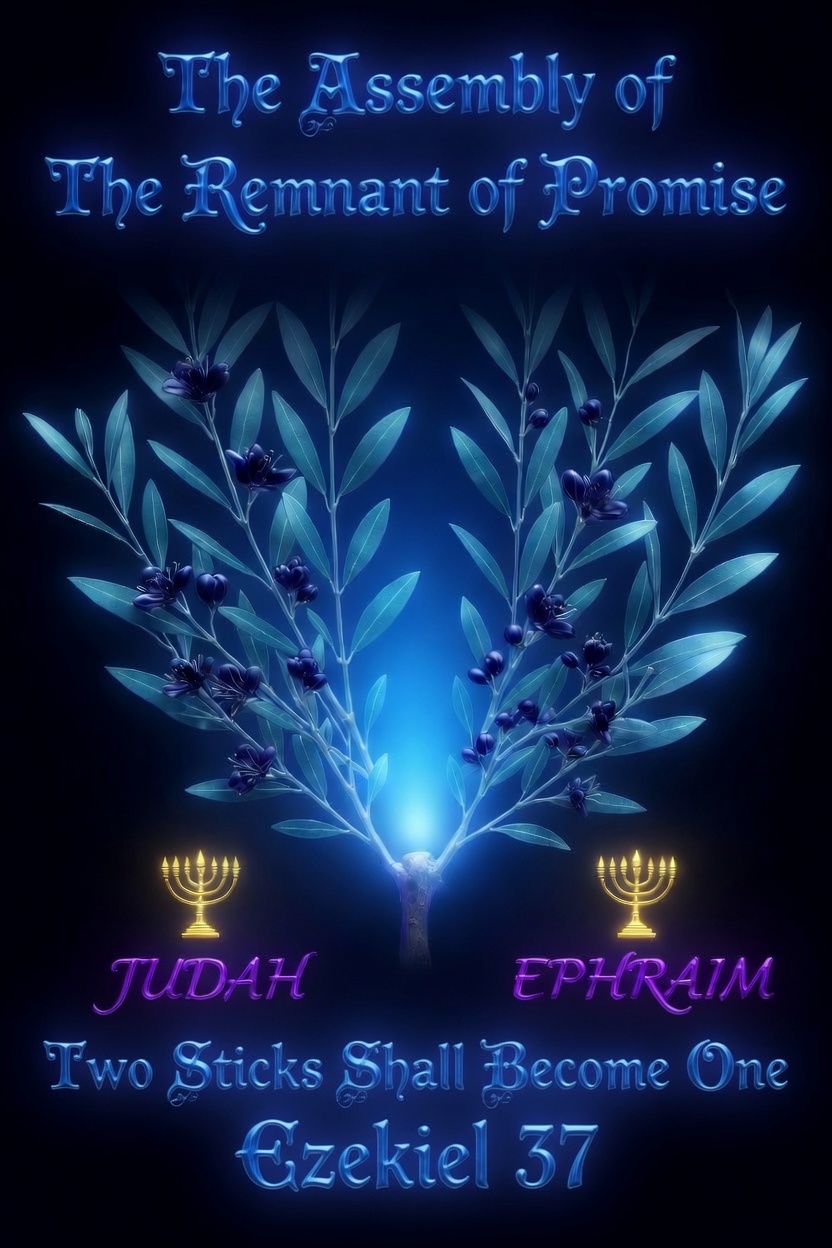
The framework of the assembly — the foundational lie all four share, the three categories the prophets actually name, and the covenant the Father promised to keep.
Every religious system that claims to carry the covenant — Christianity, Judaism, Hebrew Roots, and Islam — shares one foundational lie. All four call Yahuah (God) a liar to His face by denying the same thing: that He will gather a paternal blood remnant of all twelve tribes of Yashar’el (Israel).
The lie wears different costumes in each system, but the skeleton is the same: there is only Yahudi (Jew) and everybody else. Two categories. Yahudah (Judah) and the world. The ten northern tribes Yahuah (God) scattered through the Assyrian exile — the house of Yashar’el (Israel), the house of Ephraim, the house of Yosef — are treated as gone, absorbed, irrelevant, or spiritualized into something else. The prophets who named them, traced their scattering, and promised their restoration with precise specificity are quietly overruled by every system that needs the binary to hold.
This lie is the antichrist. Not a future figure on a throne. The antichrist is the system — in every system — that denies what Yahuah (God) promised through the prophets and calls Him a liar for having promised it. The people inside those systems are victims. The systems are the enemy.
The real framework is not two categories but three.
Yahudah (Judah). Primarily the tribes of Yahudah (Judah), with portions of Levi and Benjamin who remained after the split. The Yahudim (Jews) of the modern world. They retained their identity through exile, maintained the Torah in some form, and are identifiable as a people. They are not all of Yashar’el (Israel). They are one house of a two-house covenant people.
The Scattered Seed of Yashar’el (Israel). The ten northern tribes divorced by Yahuah (God) (Jeremiah 3:8), scattered through the Assyrian captivity, dispersed among the nations until they became indistinguishable from the nations (Hosea 1: Lo-Ammi, “not my people”). They lost their language, their Torah, their identity. They are a specific people with a paternal blood heritage — not a spiritual category, not a metaphor, not a self-selected group. The prophets named them: Ephraim, Yosef, Yashar’el (Israel), the house of the north. The prophets promised their restoration.
The Nations. Those who are not of the paternal blood seed of Yashar’el (Israel). They are not the seed of promise and never become the seed. They are not in the covenant household. They are not a branch of the olive tree of Romans 11. The Christian reading that splices the nations into Yashar’el (Israel) by faith-confession is the false inclusion gospel and it calls Yahuah (God) a liar by erasing the prophetic gathering of the twelve tribes. The good news of the kingdom is the news of the gathering, and the audience is the citizens — the lost sheep of the house of Yashar’el (Israel) — but we do not know them by sight, so the truth is proclaimed broadly. His sheep hear his voice (John 10:27); those who reject, we shake the dust off our feet and we do not cast our pearls before swine (Matthew 10:14; 7:6). The nations’ place in the millennial reign — after the dreadful day of Yahuah (God), after the burning of the tares in the land and abroad, after the first resurrection, after the wheat is sifted in the wilderness of the people — is to receive priestly instruction from the gathered remnant of the seed. That is when any relationship between the seed and the nations begins. Not now. Now is the gathering. The distinction is real and permanent and the prophets maintain it through the restoration.
Institutional Christianity rose out of the fourth beast of Daniel 7, stood up at Constantine’s Sunday Law and the Council of Laodicea, and has been asking the serpent’s Genesis 3 question from the pulpit for seventeen centuries: Did Yahuah (God) really say? The antinomian reading of Paul is its three-pillar fortress. The people in the pews are victims. They were handed this in good faith.
Judaism has built its own walls against the plain reading of the prophets regarding the Messiah and the restoration of the scattered house. Talmudic and rabbinic traditions have layered over the Torah in ways that obscure what the prophets actually said. The Yahudi (Jewish) believer is also a victim of inherited interpretation.
Hebrew Roots / Messianic / Torah Observant is the group that feels closest to truth — and this is precisely where the work must go furthest. Three inherited errors remain active here: the false inclusion gospel (anyone who believes and Torah-keeps is counted as Yashar’el (Israel)), replacement theology in Hebrew dress (the Torah-observant community replaces the specific covenant people the prophets named), and the dropped Paul (whom many Torah-observant believers cannot reconcile with the Torah they love — not because the contradiction is Paul’s, but because it is the interpreter’s).
Islam denies the covenant’s attachment to the seed of Isaac and Jacob entirely, transferring it to Ishmael. The twelve-tribe restoration is denied. The prophetic specificity of Isaiah 11, Jeremiah 31, Ezekiel 37, Hosea 1 is overruled. A different costume on the same skeleton.
In all four, the people are victims and the systems are the enemy. The tone toward the deceived is patience, not condescension. The dismantling is aimed at the system, never at the soul standing under it.
Two questions the Reformation collapsed into one and that this work always separates.
How is a person justified before Yahuah (God)? By faith. By promise. By the Messiah’s atoning work. Abraham was counted righteous before he was circumcised. The promise cannot be disannulled by the Torah that came 430 years later. Justification is entirely the Father’s gift.
How does a justified person live? By Spirit-empowered Torah observance. The new covenant of Jeremiah 31:33 is Torah written on the heart by the Spirit — not Torah abolished. The Spirit who lives in the believer is the same Spirit who spoke at Sinai. He does not lead in two directions.
These are entirely different questions. The Reformation collapsed them and chose faith alone as the answer to both, producing the antinomian gospel. The Judaizers collapsed them and chose works of the law as the answer to both, producing the flesh-performance gospel. Both collapses are wrong. Both are versions of the foundational lie. Justification is always by faith. Covenant life is always Torah-observant. The two never compete.
The Reformation took the gospel of grace and put a period where there should have been a colon. Saved by grace through faith — true. Not of works, lest any man should boast — true. That is all you need to know — false. We keep the gift exactly as scripture gives it, and complete the sentence the Reformation cut in half.
Grace is not the opposite of the Way. Grace is the means of return to Him and to His ways. The same Spirit who poured out the grace causes the walking in statutes (Ezekiel 36:27). The cross opened the door home — it did not cancel the consequence-system that still operates in this age. The post-harvest sifting tests fruit, not profession. The new heart is given to the willing. And the verdict of depart from me is mercy toward the unwilling — releasing those who said with their walk that they did not want Him from being trapped in a kingdom built around everything they refused.
We restore the names where the English translations buried them — Yahuah in place of the LORD, Yahusha in place of Jesus, Yashar’el in place of Israel, Yahudah in place of Judah, with the conventional English in parentheses on every mention so a reader meeting the names for the first time is never lost. The Father has a name. He told us it is exalted (Isaiah 12:4). We use it.
The grandmother who hung the cross loved the Father. The pastor in his pulpit loves the Father. The rabbi studying the Mishnah loves the Father. Each was handed an inheritance, in good faith, by sincere teachers who were handed it before them. The people in any system are not the enemy — they are the lost sheep. The system is the enemy. The voice of the Shepherd is calling the scattered home, and when it lands, it lands gently. We love the souls inside them. We dismantle systems with the Word, and we trust the Father to do the work in the heart.