From the Work
There is a verdict that has been spoken over Yahuah (God)’s sheep for seventeen centuries, and the people speaking it did not have the authority to speak it. You are not his people. You never were. The covenant has been transferred. The seed has been retired. The promises went elsewhere. That is the verdict the inherited pulpit has been pronouncing — sometimes loudly from a stage, more often quietly through the structure of every sermon — over the very seed Yahuah (God) himself named, traced through every page of the prophets, and swore he would gather home.
The verdict was a lie when it was first spoken in the fourth century. It is a lie now. The promise was never cancelled. It is being kept in front of the awakening reader’s face, and the pulpit cannot see what is happening because the pulpit has been the verdict’s loudest voice.
This essay is about the verdict and the promise that overrides it.
Open the older covenant and listen to what Yahuah (God) actually swore. The promise begins with a man and his sons. Abraham. Isaac. Jacob. Twelve sons came from Jacob. Twelve tribes came from those sons. The covenant Yahuah (God) made was with Abraham, and his oath unto Isaac; and confirmed the same unto Jacob for a law, and to Yashar’el (Israel) for an everlasting covenant (Psalm 105:9–10). Everlasting. That is the word the prophets used. The pulpit later put a stop on it. The pulpit was not the one who swore it.
The covenant landed on a paternal blood seed. Yahuah (God) named the seed by the patriarchs. He traced the seed through the genealogies. He multiplied the seed in Egypt. He brought the seed out of Egypt. He set the seed in the land. He named twelve tribes one by one in the camp around the tabernacle. The covenant has names attached to it. It is not abstract. It is not a category. It is twelve real, named, traceable lineages with the promise of Yahuah (God) over them.
Then they broke the covenant. The northern ten tribes pulled away after Solomon, went after other gods, and Yahuah (God) gave them a bill of divorce — I had put her away, and given her a bill of divorce (Jeremiah 3:8). The Assyrian captivity carried them off in the eighth century BC, and they were scattered among the nations. They lost the language. They lost the Torah. They lost the name they had been given. Lo-Ammi — not my people (Hosea 1:9). They forgot whose they were.
But here is the line the pulpit has not been preaching. The very same prophet who carried the Lo-Ammi verdict carried the promise that overrules it, in the very next breath.
In the place where it was said Lo-Ammi, there it shall be said sons of the living Elohim (God). Same place. Same people. The verdict was for a season. The reversal was promised in the same chapter.
What happened in the fourth century is the chapter most readers have never been walked through. When institutional Christianity rose in the era of Constantine and Theodosius, it took the seat of the covenant for itself. It declared its own assembly the new Yashar’el (Israel). It pronounced over the scattered seed the very Lo-Ammi the Father had promised to lift — and froze it in place as if the prophets had not already promised the season would end.
The lie has a date. The Council of Nicaea was 325 AD. The Council of Laodicea, anathematizing the seventh-day Sabbath keepers, was 363 AD. The Edict of Thessalonica, making the new state religion mandatory, was 380 AD. The pulpits that came out of those councils declared themselves the inheritors of the covenant. They told the seed Yahuah (God) had scattered that the seed had been retired. They told the body of the covenant people that they were not his.
That verdict has been preached for seventeen centuries. It has shaped every commentary, every catechism, every Sunday-school lesson, every seminary curriculum. It is in the air of the room a Christian reader was born into. It is so deep that most readers do not even hear it as a verdict; they hear it as the natural background of what the gospel is.
It is not the natural background. It is the counterfeit. The pulpit that pronounced it had no authority to pronounce it. The promise of Hosea 1:10 stood while the pulpit was speaking. The seed of promise was scattered while the pulpit was speaking. The Father knew exactly where every member of the divorced house was, even when the divorced did not know themselves. The eyes of Yahuah (God) are in every place, beholding the evil and the good (Proverbs 15:3). The pulpit forgot. The Father did not.
This is the part the awakening reader has to hear plainly, because the pulpit has muddied it.
Some Hebrew Roots teaching has framed the Lo-Ammi as a kind of identity-feeling that the awakened reader carries — I felt like I was not his people, and now I feel like I am. That framing is not what the verse is doing. The Lo-Ammi of Hosea 1 was a verdict Yahuah (God) himself spoke over the divorced northern house for a season, with the very same prophet immediately announcing the season’s end (Hosea 1:10). It was a covenant verdict, not an identity-feeling.
What has been functioning over the sheep for seventeen centuries is a counterfeit Lo-Ammi — the fourth-century pulpit’s verdict, not the Father’s. The I never knew you the inherited Christian reader has been told to fear was being borrowed by the system itself and pronounced over the very seed the Father promised to gather. The pulpit took the Father’s verse and turned it on the wrong people.
So this essay is not asking the awakening reader to feel the Lo-Ammi one more time. It is exposing the lie that has been speaking it over the sheep. The Father’s Lo-Ammi was for a season; the season ended in his promise of restoration; the pulpit’s Lo-Ammi was a counterfeit, voted in at councils, preached for centuries, and never had the authority to stand. The awakening reader does not need to inhabit the verdict. The reader needs to see who has been speaking it, and on whose authority, and to recognize that the speaking does not change what the Father swore.
The promise the prophets carried is specific. I will take you from among the heathen, and gather you out of all countries, and will bring you into your own land (Ezekiel 36:24). And it shall come to pass in that day, that Yahuah (God) shall set his hand again the second time to recover the remnant of his people, which shall be left, from Assyria, and from Egypt, and from Pathros, and from Cush, and from Elam, and from Shinar, and from Hamath, and from the islands of the sea. And he shall set up an ensign for the nations, and shall assemble the outcasts of Yashar’el (Israel), and gather together the dispersed of Yahudah (Judah) from the four corners of the earth (Isaiah 11:11–12).
The gathering is a recovery. Of a remnant. From specific places. From the four corners of the earth. And — this is the line that explodes the pulpit’s binary — both the outcasts of Yashar’el (Israel) and the dispersed of Yahudah (Judah). Two distinct bodies, named separately, gathered the second time. The first time was the partial return from Babylon under Zerubbabel and Ezra. The second time is the full ingathering of all twelve tribes the prophets promised. Herod’s temple at the Messiah’s first coming was not the second time. The modern state of Israel today is not the second time. The full ingathering of all twelve tribes is still being completed.
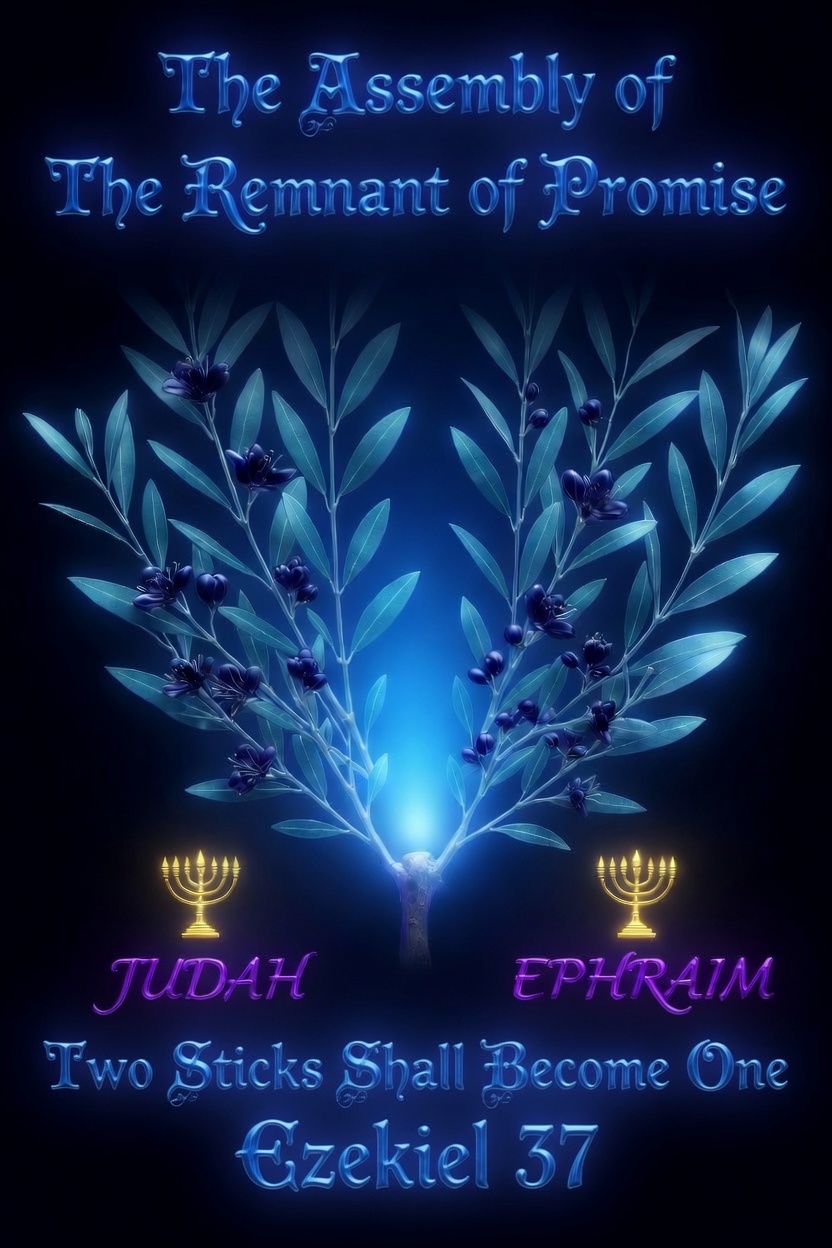
Ezekiel takes two sticks and joins them in his hand: Behold, I will take the stick of Joseph, which is in the hand of Ephraim, and the tribes of Yashar’el (Israel) his fellows, and will put them with him, even with the stick of Yahudah (Judah), and make them one stick, and they shall be one in mine hand (Ezekiel 37:19). Two sticks. Two houses. Made one in the Father’s hand. The promise is not the absorption of one into the other. The promise is the joining of both, by Yahuah (God) himself, into a single restored covenant people.
Jeremiah’s new covenant is named with the same architecture. Behold, the days come, saith Yahuah (God), that I will make a new covenant with the house of Yashar’el (Israel), and with the house of Yahudah (Judah) (Jeremiah 31:31). Both houses named. The new covenant is with both. It is not made with the assembly that pronounced Lo-Ammi over the sheep. It is made with the sheep.
When Yahusha (Jesus) said I am not sent but unto the lost sheep of the house of Yashar’el (Israel) (Matthew 15:24), he was not being narrow. He was being precise. The lost sheep are a specific people the prophets had named for centuries. He came for them. Other sheep I have, which are not of this fold: them also I must bring, and they shall hear my voice; and there shall be one fold, and one shepherd (John 10:16). The other sheep are not heathen converts grafted onto Yashar’el (Israel) by faith alone. They are the lost sheep of the scattered house — separated from the southern fold by seven centuries of exile when Yahusha (Jesus) spoke that line, scattered further still when he ascended, and being gathered now through the same Shepherd’s voice.
Paul carried the same mission. He quoted Hosea 1:10 in Romans 9:25–26 — the sons of the living Elohim (God) being called in the place where the Lo-Ammi was spoken. He cited Isaiah 49:6 in Acts 13:47 — to raise up the tribes of Jacob and to restore the preserved of Yashar’el (Israel). He knew exactly who he was being sent to. The apostle to the Gentiles was the apostle to the scattered seed living as Gentiles among the nations because they had forgotten whose they were. The pulpit later flattened that into Gentiles equals heathen and lost the architecture of Paul’s whole mission.
Here is the part that lands wherever the awakening reader is sitting right now. The promise is being kept. Right now. In real time. Across every continent. Among real people the Father is calling out by name, one verse at a time, who are putting down the inherited gospel and picking up the prophets and noticing what the prophets actually said.
Some of those people are coming out of institutional Christianity. Some are coming out of Judaism. Some are coming out of Islam. Some are coming out of nothing — third-generation atheists who picked up a Bible and started reading. Some are coming out of Hebrew Roots’ false inclusion gospel into a clearer reading. Wherever they were, the Father knew where they were. He calleth his own sheep by name, and leadeth them out… the sheep follow him: for they know his voice (John 10:3–4). The voice is the Shepherd’s. The hearing is the seal of the sheep.
This is not a movement someone built. There is no headquarters. There is no central organization coordinating the awakening across continents. People who have never met are reading the same verses and hearing the same Shepherd and arriving at the same prophetic ground because the Father is the one calling. I will surely assemble, O Jacob, all of thee; I will surely gather the remnant of Yashar’el (Israel) (Micah 2:12). The assembling is happening. The gathering is happening. The pulpits will say it cannot be. The Father is doing it anyway.
This essay is not handing the reader a credential. It is naming what scripture has been carrying for thirty centuries and what is happening now. Surely our fathers have inherited lies (Jeremiah 16:19). The verdict that the seed was retired was one of those lies. The verdict was spoken with conviction. It was preached for seventeen centuries. It changed nothing about what Yahuah (God) actually said.
The promise was never cancelled. The seed is being recovered. The two sticks are joining in his hand. The new covenant is being made with both houses, just as Jeremiah said it would be. The lost sheep are hearing the Shepherd’s voice. The hour the Father appointed has come.
Read the prophets. Read Hosea 1:10 in its place. Read Ezekiel 36 and 37. Read Isaiah 11. Read Jeremiah 31. Read Romans 11 with Paul actually arguing what Paul actually argued. Let the Word say what the Word says. The pulpit will say it cannot be. The Father is doing it anyway.
The Deliverer is keeping the oath. The promise is being kept. Walk the road with the Father.
A deeper dive — if the work has fed you