From the Work
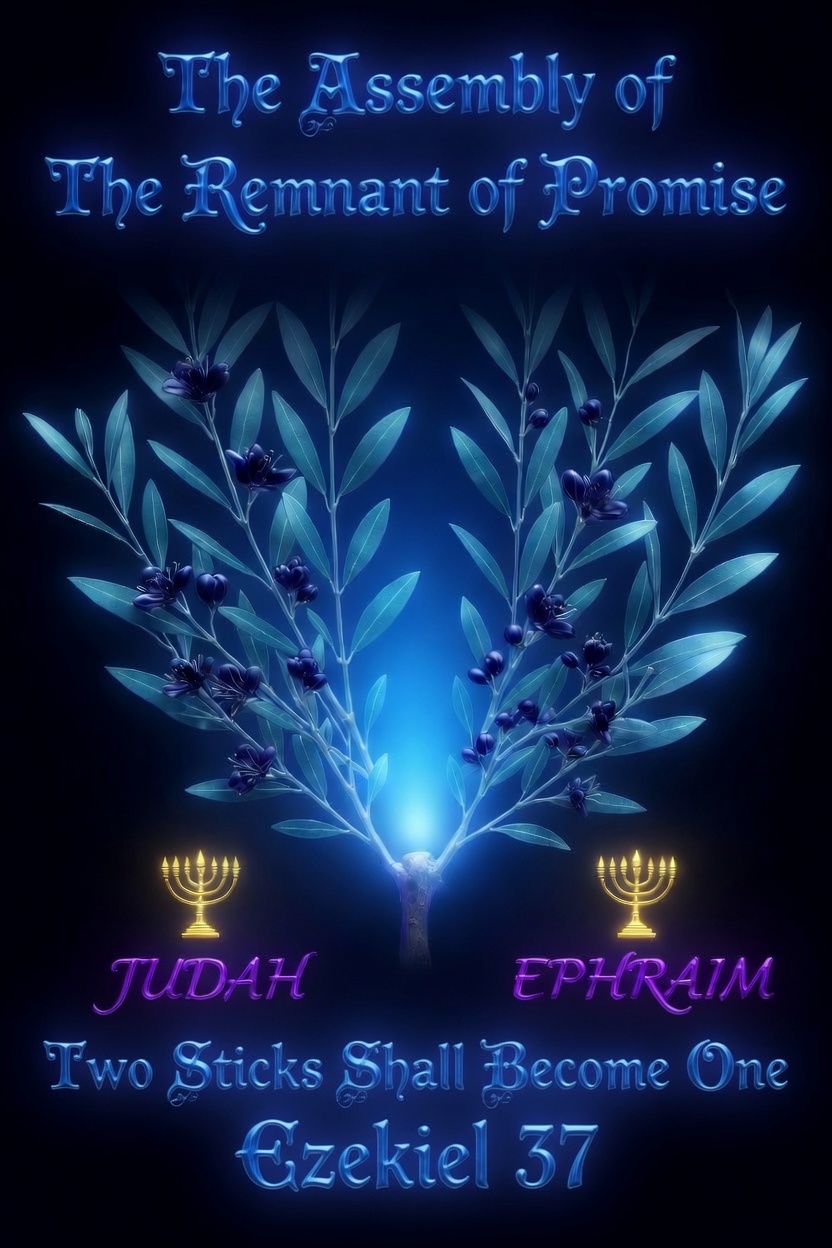
There is a moment in Ezekiel that the inherited pulpit hurries past too quickly. Yahuah (God) tells the prophet to take two sticks and write on them. Take thee one stick, and write upon it, For Yahudah (Judah), and for the children of Yashar’el (Israel) his companions: then take another stick, and write upon it, For Joseph, the stick of Ephraim, and for all the house of Yashar’el (Israel) his companions: And join them one to another into one stick; and they shall become one in thine hand (Ezekiel 37:16–17).
Two sticks. Two houses. Joined in the prophet’s hand as a sign of what Yahuah (God) was going to do with his own hand. The pulpit usually treats this as a quaint Old Testament prophecy fulfilled long ago in some vague sense — maybe at the second temple, maybe at Pentecost, maybe in the assembly that vote-counted itself the new Yashar’el (Israel). None of those answers fits what Ezekiel said.
The two sticks are still in the prophet’s hand. The Father has been joining them, on his own schedule, and the joining is happening in the awakening reader’s lifetime. This essay walks the keystone — the two-house restoration the prophets named, the wild olive of Romans 11 read carefully, and what is actually happening in front of the awakening reader’s eyes.
The covenant began with one man. Abraham. It carried through Isaac, through Jacob, through the twelve sons that came from Jacob. By the time of Moses, the twelve tribes were a people the Father had named one by one in the camp around the tabernacle. The covenant had specific names attached to it. It was not abstract.
After Solomon, the kingdom split. And so Yashar’el (Israel) rebelled against the house of David unto this day (1 Kings 12:19). Ten tribes pulled north under Jeroboam and became the House of Yashar’el (Israel) — also called the House of Joseph, also called Ephraim. Two tribes plus portions of Levi held south as the House of Yahudah (Judah). The names scripture uses for the two houses are not interchangeable. They are the covenant’s actual shape.
The northern house broke the covenant first. They went after other gods. Yahuah (God) gave them a bill of divorce — I had put her away, and given her a bill of divorce (Jeremiah 3:8). The Assyrian captivity carried them off in the eighth century BC, and they were scattered among the nations. Yahuah (God) shall scatter thee among all people, from the one end of the earth even unto the other (Deuteronomy 28:64). They lost the language. They lost the Torah. They lost the name they had been given. Lo-Ammi — not my people (Hosea 1:9). They forgot whose they were.
The southern house kept its identity through the Babylonian exile and the partial return. The second temple under Zerubbabel, the rebuilding under Ezra and Nehemiah — those were a real return, but they were not the prophetic ingathering of all twelve tribes the prophets had promised. Herod’s temple at the Messiah’s first coming was still only Yahudah (Judah) in the land. The modern state of Israel today is still only Yahudah (Judah) in the land. The full ingathering of all twelve tribes is still being completed.
That is the geography under everything that follows. Two houses. One divorced and scattered. One kept and partially returned. Both promised home. The Father has not retired the picture.
Open the prophets and listen for which houses are named.
Both. The new covenant is not made with one. It is made with both, named separately, the divorced and the kept brought into the same new arrangement.
One nation. Out of two. In the land. Under one king. The pulpit has read this as some metaphor for the assembly. Ezekiel is not being metaphorical. He is saying what he is saying. Two houses become one, in the land, under the Messiah (Christ), as the keeping of the oath the Father swore.
David’s house. Reassembled. Ruins raised. As in the days of old — meaning before the split, before the divorce, before the scattering. James cited this verse at the council of Jerusalem (Acts 15:16) as the prophetic anchor for what the Father was doing among the gathering of the lost sheep. The breach being closed is the breach between the two houses. James saw it. The pulpit later forgot what he saw.
When Yahusha (Jesus) said I am not sent but unto the lost sheep of the house of Yashar’el (Israel) (Matthew 15:24), he was not narrowing his mission. He was naming who he had come for. The lost sheep are a specific people the prophets had named for centuries. He came for them.
And then a few chapters later, in John, he widens the picture without changing the people. Other sheep I have, which are not of this fold: them also I must bring, and they shall hear my voice; and there shall be one fold, and one shepherd (John 10:16). The other sheep are not heathen converts grafted onto Yashar’el (Israel) by faith alone. They are the lost sheep of the scattered house — separated from the southern fold by seven centuries of exile when Yahusha (Jesus) spoke that line, scattered further still when he ascended, and being gathered now through the same Shepherd’s voice. The fold he is gathering is one fold under one Shepherd, and that fold is the two houses joined.
His earthly mission was the keeping of the two-house promise. The cross was the door home for the divorced. The blood was the price that paid the curse the divorced had earned. The resurrection was the seal that the door home was open and the Shepherd was alive to keep gathering the sheep he had named.
Romans 11 is the chapter the inherited pulpit has used to teach replacement theology in two directions. The Christian reading uses it to graft heathen onto Yashar’el (Israel) by faith and call them the new natural branches. The Hebrew Roots false-inclusion reading uses it to graft Torah-keepers from any background onto Yashar’el (Israel) and call them the seed of promise. Both readings get Paul wrong.
What Paul actually says is more layered, and the layered reading is the one that holds.
The olive tree is the covenant root, planted in Abraham, Isaac, and Jacob. The natural branches are the covenant lineage carried through the patriarchs into the twelve tribes — the line of Adam carried forward through the fathers, named by Yahuah (God), traced through scripture. That line was broken off when both houses fell into unbelief. The northern house fell first; the southern house fell at the rejection of the Messiah (Christ). Both houses were broken off. Because of unbelief they were broken off (Romans 11:20). The natural branches are not a living group walking around today. They are the broken-off, the patriarchs, the prophets, and the faithful of every generation back, asleep, awaiting the resurrection.
Graffed in again — the natural branches grafted back into their own root. The forefathers who walked the covenant faithfully in their lifetimes are the natural branches whom Yahuah (God) is able to graft in again at the first resurrection (1 Thessalonians 4:15–17; Hebrews 11:39–40; Revelation 20:4–6). Even Paul did not presume on attaining it (Philippians 3:11) — the first resurrection is conditional on faithfulness, not automatic on lineage.
For the broken-off who died still in unbelief, the proclamation came to them too. Yahusha (Jesus) descended to the dead and preached (1 Peter 3:18–20; 4:6; John 5:25 — the dead shall hear the voice of the Son of Yahuah (God): and they that hear shall live). Those who could hear ceased to abide in unbelief and can be grafted in. Those who could not hear remained as they were and face the second resurrection of judgment.
The wild olive branches are us — the living descendants of the broken-off. Both modern Yahudah (Judah) and the modern scattered seed of Yashar’el (Israel) are children of the broken-off. The wild olive grew up among the nations through centuries of exile, still olive, always olive, never anything else. Yahuah (God) is grafting the wild olive back into its own natural root. That is the picture. Not heathen onto Yashar’el (Israel). Yashar’el (Israel) back into Yashar’el (Israel) through the journey of the prophets.
Romans 11 does not stand alone. The prophets walked out the journey the wild olive takes home, and the steps are what Paul is leaning on when he says and so all Yashar’el (Israel) shall be saved (Romans 11:26).
Step one: gathered out of the nations. Therefore, behold, the days come, saith Yahuah (God), that they shall no more say, Yahuah (God) liveth, that brought up the children of Yashar’el (Israel) out of the land of Egypt; But, Yahuah (God) liveth, that brought up the children of Yashar’el (Israel) from the land of the north, and from all the lands whither he had driven them: and I will bring them again into their land that I gave unto their fathers (Jeremiah 16:14–15). The gathering out is the first step. It is happening now.
Step two: brought under the rod into the wilderness. And I will bring you into the wilderness of the people, and there will I plead with you face to face (Ezekiel 20:35). The wilderness is the place of refining. The rod is the Father’s hand. I will cause you to pass under the rod, and I will bring you into the bond of the covenant (Ezekiel 20:37). Some of this happens in the literal future wilderness Ezekiel names; some of it happens in the awakening reader’s life right now, as the inherited gospel is dismantled and the Father strips away the carried lies.
Step three: the rebels purged. And I will purge out from among you the rebels, and them that transgress against me (Ezekiel 20:38). The wheat is gathered out of all nations into the wilderness, and then a second sifting separates the fruitful from the unfruitful within the gathered (see §IV). This is not the harvest of wheat-from-tares; that already happened. This is the post-harvest sifting of chaff-from-kernel within the gathered wheat itself.
Step four: brought into the bond of the new covenant. Behold, the days come, saith Yahuah (God), that I will make a new covenant with the house of Yashar’el (Israel), and with the house of Yahudah (Judah)… I will put my law in their inward parts, and write it in their hearts (Jeremiah 31:31, 33). The Spirit writes Torah on the heart of the gathered. The new heart is given (Ezekiel 36:26–27). The walking in statutes becomes the new heart’s native motion.
Step five: grafted into the natural root of the fathers. How much more shall these, which be the natural branches, be graffed into their own olive tree? (Romans 11:24). The grafting is the destination of the journey. Not the doorway. The wild olive comes home through the journey the prophets named, and at the end of the journey the wild olive is grafted into its own natural root. The fathers come up at the resurrection. The remnant joins them. The two houses become one nation under the Messiah (Christ) in the land.
Here is the cause-and-effect that distinguishes the framework from the false-inclusion gospel. The pulpit has taught: if you hear and confess, you become a child of Yahuah (God). Scripture says the opposite: if you are a child of Yahuah (God), you will hear when he calls.
Read those together. The believing follows the being. The hearing follows the lineage. The reader who hears the Shepherd and the verses crack open under his hand and the prophetic gathering starts to make sense — that reader is hearing because he is a sheep. He did not become a sheep by hearing. He heard because he was. If you hear, that is because. Election precedes hearing. Lineage precedes response.
This is the line that protects the framework from collapsing back into the false-inclusion gospel. We do not declare any reader’s lineage. The Father knows. The eyes of Yahuah (God) are in every place (Proverbs 15:3). The hearing is the seal. The hearing reveals what was always true. The pulpit will say anyone can be added by faith confession. Scripture says no name is added after the foundation of the world. Whose names are not written in the book of life of the Lamb slain from the foundation of the world (Revelation 13:8). Names can only be blotted out (Exodus 32:33; Revelation 3:5) — and the warning to be blotted out is given to wheat, not to tares. The tares cannot become wheat by trying. The wheat can lose its place by lawlessness.
This is not exclusion. The other nations who survive the harvest are loved, welcomed, taught, blessed. They walk alongside the covenant household as Torah stranger and sojourner. They come up to receive Torah from Tsion (Zion) in the millennial reign. Every one that is left of all the nations which came against Jerusalem shall even go up from year to year to worship the King, Yahuah (God) of hosts, and to keep the feast of tabernacles (Zechariah 14:16). The kingdom of priests has nations to serve. That is what the priestly remnant is for.
The two sticks are still in the prophet’s hand. The Father is joining them in his own time, by his own hand. The wild olive is being gathered out of every nation where it grew up. The journey home has steps the prophets named, and the awakening reader is somewhere along the journey right now — at the gathering, at the wilderness, at the refining, at the bond of the new covenant. The Father knows where each of his sheep is. The Spirit walks them at his own pace.
All Yashar’el (Israel) — both houses, the full twelve tribes the prophets named — gathered home through the journey the prophets walked out, sealed at the end by the Deliverer who came out of Tsion (Zion). Read Ephraim Rising for the full treatment of the two-house restoration; this essay only walks the keystone.
If you are reading this and the verses are landing, the Shepherd is calling. We do not declare your lineage. The Father knows. Hear. Walk. The journey home is real. The destination is sure.
Read the prophets. Open the scrolls. Walk the road with the Father.
A deeper dive — if the work has fed you